When the Student Leads: How Junior Developers Are Rewriting the Rules of Corporate Mentorship

For decades, corporate mentorship has followed a predictable script. A seasoned executive imparts wisdom to an eager newcomer. Experience flows downward through org charts like water finding the path of least resistance. It is a model that has served organizations reasonably well—until the distributed, transparent, and radically collaborative nature of modern software development began exposing its limitations.
Today, a growing number of American companies are discovering something that open-source communities have quietly understood for years: expertise does not respect seniority, and the most valuable knowledge in a room sometimes belongs to the person who joined the team six months ago.
The Open-Source Blueprint for Bidirectional Learning
Anyone who has spent time contributing to a major open-source project on platforms like GitHub or GitLab has encountered a particular dynamic. A developer with two years of experience submits a pull request that draws substantive feedback—not just from peers, but from project maintainers who have been writing code for two decades. The exchange is collaborative, not hierarchical. Credit flows to the quality of the contribution, not the contributor's title.
This model creates something rare in traditional corporate environments: a genuine feedback loop where knowledge travels in multiple directions simultaneously. Junior contributors regularly introduce maintainers to new libraries, more efficient patterns, or emerging community conventions that senior developers simply have not had time to explore. The structure rewards curiosity and current knowledge as much as it rewards accumulated experience.
The implications for organizational learning are significant. Companies that have begun modeling internal mentorship programs on these principles are reporting outcomes that traditional top-down programs rarely produce.
What Senior Leaders Are Missing—And Who Can Teach Them
Consider the specific skills that distributed, open-source collaboration demands: asynchronous communication, transparent documentation, comfort with public feedback, and fluency in tools that facilitate decentralized decision-making. These are not soft skills in the traditional sense. They are operational competencies that determine whether a modern engineering team can function effectively across time zones, disciplines, and organizational boundaries.
Here is the uncomfortable reality for many senior leaders: their junior colleagues frequently outperform them in precisely these areas. A developer who entered the workforce after 2018 has likely spent years navigating pull request reviews, writing detailed commit messages for public consumption, and participating in open forums where ideas are evaluated on their merits. Their manager, by contrast, may have built a career in environments where decisions were made in conference rooms and institutional knowledge lived in someone's head rather than a shared repository.
Organizations that acknowledge this gap—rather than pretending it does not exist—are positioning themselves to close it.
Structured Reverse Mentorship in Practice
Several US-based technology firms have begun formalizing what practitioners are calling reverse mentorship programs, pairing senior leaders with junior employees for structured learning engagements focused specifically on the skills that open-source collaboration has made essential.
At one mid-sized software company in Austin, Texas, the engineering leadership team implemented a program in which managers were paired with developers who had fewer than three years of professional experience but strong open-source contribution histories. The explicit goal was not general knowledge transfer. It was targeted: senior leaders would learn, firsthand, how distributed review processes work, how to give feedback in writing that is both honest and constructive, and how to build consensus in environments where authority is earned rather than assigned.
The results challenged assumptions that had shaped the company's culture for years. Several managers reported that the experience fundamentally changed how they ran team meetings and structured project documentation. More than a few acknowledged that they had been conflating seniority with expertise in ways that were quietly discouraging their most capable junior employees.
The Psychological Barrier—And How to Dismantle It
The most significant obstacle to reverse mentorship is not logistical. It is psychological. Asking a senior leader to position themselves as a learner in relation to someone they manage requires a degree of professional humility that many organizational cultures actively discourage.
Open-source communities navigate this challenge through structural design. The code review process, for instance, is built on the assumption that any contributor—regardless of status—can and should receive substantive feedback. The norms around that process make receiving critique feel routine rather than threatening. It is a feature of the system, not an exception to it.
Companies seeking to replicate this dynamic internally would do well to focus on structural design before they focus on individual attitudes. Creating formal channels through which junior employees are explicitly invited to evaluate and comment on leadership practices—analogous to a pull request review—does more to normalize bidirectional feedback than any amount of cultural messaging.
This is where platforms built around open skills development can play a meaningful role. When organizations invest in training that teaches both junior and senior employees the norms and mechanics of collaborative review, they create a shared vocabulary that makes reverse mentorship feel less like an organizational experiment and more like standard operating procedure.
What Established Leaders Gain
It is worth being precise about what senior leaders stand to gain from this kind of engagement, because the value extends well beyond technical tool fluency.
Junior developers who have been active in open-source communities tend to have sophisticated instincts about how transparent systems build trust, how to write documentation that serves future contributors rather than just current ones, and how to structure decisions so that the reasoning behind them is visible and revisitable. These are leadership skills. They are increasingly essential leadership skills in organizations that depend on distributed teams and cross-functional collaboration.
A vice president of engineering who learns to think about internal communication the way a thoughtful open-source maintainer thinks about project documentation is not simply acquiring a new habit. They are developing a fundamentally different mental model of what organizational knowledge is, who it belongs to, and how it should be structured to remain useful over time.
Building the Infrastructure for Mutual Growth
Reverse mentorship does not thrive in organizations that treat it as a one-time initiative. It requires the same kind of sustained infrastructure that successful open-source projects require: clear contribution guidelines, regular cadences for review and reflection, and a genuine commitment to acting on feedback rather than simply collecting it.
For organizations ready to make that investment, the payoff is substantial. Teams that practice bidirectional mentorship consistently report stronger cross-generational collaboration, higher retention among junior employees who feel genuinely valued, and leadership teams that are better equipped to navigate the realities of modern software development.
The open-source community figured this out through necessity. Distributed projects cannot afford to let good ideas go unrecognized because they came from someone without a senior title. American companies that are willing to apply the same logic internally will find that they have been sitting on a significant and largely untapped source of competitive advantage.
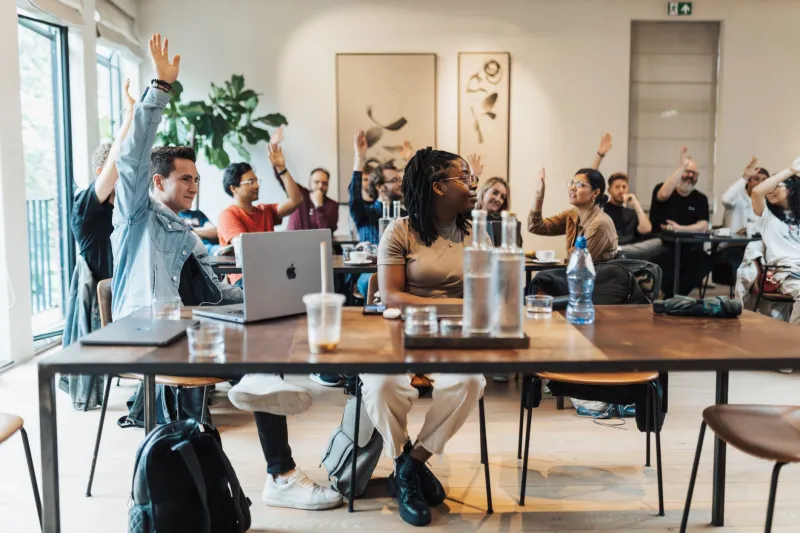
The junior developer at the end of the table may not have the experience of the room. But they may well have exactly the skills the room needs most.