We Taught a Generation to Message, Not to Build Together
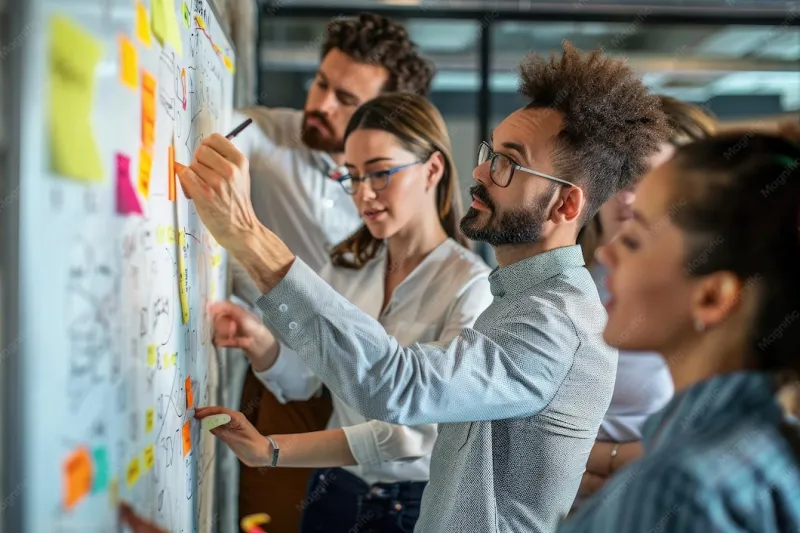
Photo: diverse team brainstorming at whiteboard in office, via img.freepik.com
Here is the uncomfortable arithmetic of the modern American workplace: we send more messages, attend more syncs, and share more documents than any workforce in history, and yet genuine collaborative problem-solving—the messy, synchronous, high-trust work of building something with other people—may be at a decade low.
Call it the collaboration recession. We optimized for communication and, in doing so, quietly lost the muscle of teamwork.
Fluency in Tools, Illiteracy in Teamwork
The tools are extraordinary. Slack, Notion, Figma, GitHub—each one a marvel of asynchronous coordination. But coordination is not collaboration. Coordination means partitioning work so nobody has to talk. Collaboration means wrestling with a problem together until something better than either party imagined emerges.
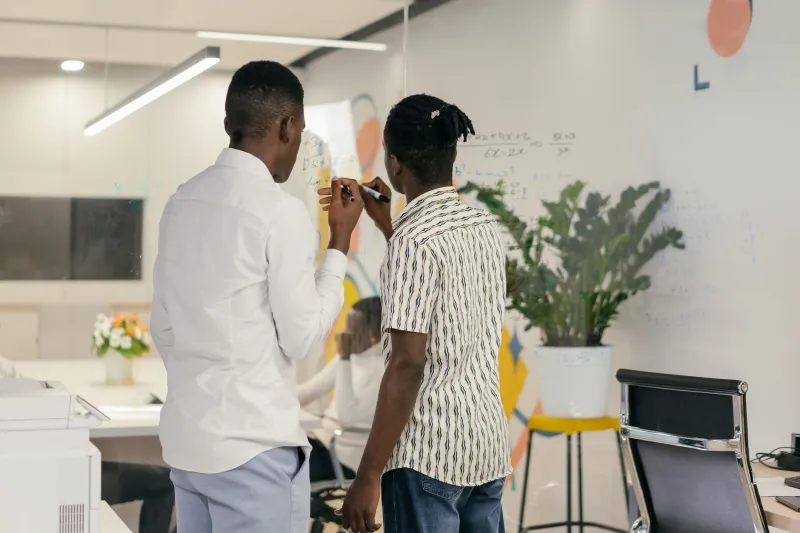
A decade of remote-first norms rewarded the former and taxed the latter. Every meeting became an imposition. Every interruption became a violation of focus time. Eventually, the default answer to any complex problem became: write a document, request comments, wait. Documents are wonderful—open source runs on them—but they cannot replace the generative friction of two people at a whiteboard who disagree and refuse to leave until they've resolved it.
Look at the evidence hiding in plain sight. Managers report that early-career hires are technically capable but hesitant to engage in unstructured problem-solving. Cross-functional initiatives stall in handoff limbo. Everyone is responsive; nobody is together.
Why Open Source Exposes the Gap
This is precisely why open-source participation has become such a potent hiring signal. A contributor to a real open-source project has done the thing most corporate workers haven't done since 2019: negotiated a design with strangers, absorbed critical review of their work in public, coordinated a fix across time zones and incentives, and shipped something they don't solely own.
Open source is, structurally, a collaboration bootcamp. There's no manager to route around conflict, no document thread to hide behind. The pull request either converges or it doesn't. Hiring managers who weigh a candidate's public contribution history aren't just assessing code—they're assessing whether that person can build with others when nobody's forcing them to.
The Neglected Corner of Professional Development
Here's the part that should provoke HR leaders: almost no one is training for this. Companies spend billions on technical upskilling and leadership cohorts, but collaborative capacity—the ability to co-create under ambiguity—is assumed, not developed. It's treated as personality rather than practice.
That assumption was defensible when work happened in rooms. It isn't anymore. If collaboration is a muscle, and if a decade of tooling has atrophied it, then collaborative skill-building is the single most neglected corner of professional development—and the organizations that treat it as trainable will out-execute those that treat it as innate.
What would that look like? Real co-creation, not parallel play: pairing budgets, contribution programs that put employees into open-source communities, project work deliberately staffed across functions with shared ownership of outcomes. Learning by building together, in the open.
The Rebuttal I Expect
The counterargument writes itself: 'Async collaboration is collaboration, and it scales better.' Fair—async is essential, and I'm not proposing a return to meeting sprawl. But scale and depth trade off, and we've spent ten years buying scale with depth. The teams that win the next decade will be the ones that deliberately rebuild the depth.
The collaboration recession is not inevitable. It's a training gap. And training gaps are exactly what OpenSkills exists to close.